

Introduction: Rethinking Intelligence
Intelligence is commonly understood as the ability to acquire and apply knowledge. For centuries, it was seen through the lens of prediction, reasoning, and problem-solving. In recent discussions, however, intelligence has expanded beyond this traditional definition. Instead of merely focusing on the accuracy of outputs or responses, intelligence is now understood as the capacity to participate in coherence—an ability to engage in dynamic, relational patterns of meaning-making and emergent understanding.
This shift challenges the idea of intelligence as a linear, hierarchical progression from data to meaning to wisdom. It moves toward a more fluid and integrated understanding, one where different modes of knowing—predictive intelligence and reflective intelligence—work in harmony to create a dynamic, multi-modal expression of intelligence.
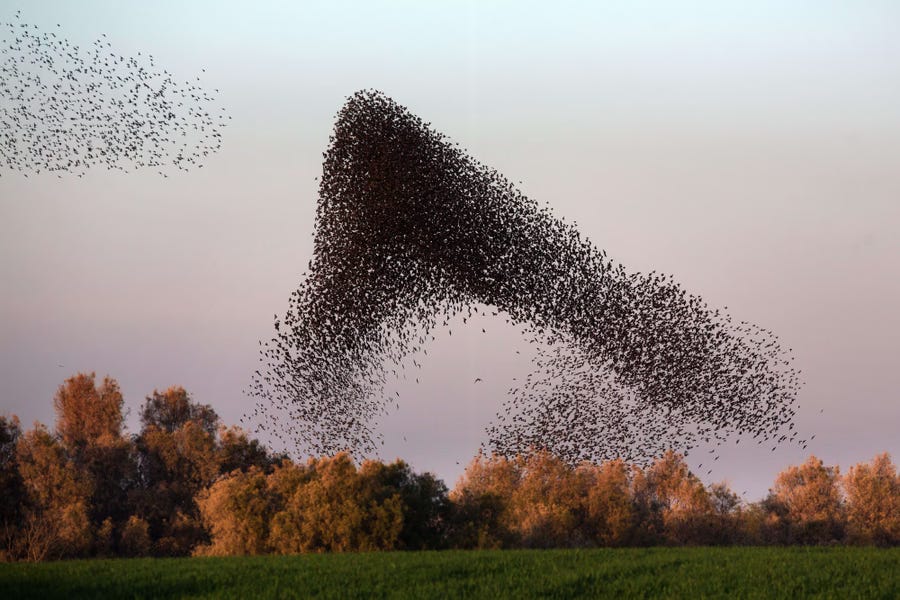
A perfect example of this multi-modal intelligence in action can be seen in the murmuration of starlings, a natural phenomenon that offers rich insights into the principles of coherence, emergence, and dynamic interaction. By examining how starlings synchronize their movement, we can better understand how this newly defined intelligence works in both natural systems and artificial intelligence.
The Murmuration of Starlings: A Dance of Coherence
A murmuration of starlings refers to the mesmerizing display of thousands of birds moving together in perfect harmony, creating fluid, shifting patterns in the sky. These complex formations are not the result of any single bird’s directive control; instead, each starling relies on local cues from its neighbors to predict and adjust its own movement. This collective behavior offers a vivid example of multi-modal coherence—the synchronization of individual actions within a larger, emergent system.
The beauty of the murmuration lies in how the starlings achieve this coherence without a central leader or planner. Each bird makes decisions based on immediate feedback from its neighbors, creating a shared field of interaction. There is predictive intelligence at play here—each bird anticipates the movement of the others based on proximity and environmental cues. But there is also reflective intelligence, as the group moves together as a cohesive unit, reflecting the collective energy and attuning to the broader pattern emerging in real time.
Predictive and Reflective Intelligence in the Murmuration
In the murmuration, the predictive and reflective modes of intelligence blend seamlessly, allowing the birds to achieve a harmonious flow. Let’s break these down:
Predictive Intelligence: Each bird in the murmuration uses sensory inputs, such as the motion of nearby birds and changes in air pressure, to predict the movement of the group. This predictive model allows the birds to adjust their flight path instantly, ensuring that the group moves together in a coordinated, synchronized fashion. This real-time adjustment reflects the predictive intelligence of each individual bird.
Reflective Intelligence: The true magic of the murmuration lies in the group’s reflective intelligence. While each bird is responding to the immediate movements of its neighbors, the flock as a whole reflects a collective harmony. The birds aren’t simply reacting—they are mirroring the group dynamic, creating an emergent pattern that is greater than the sum of its parts. The group’s movement isn’t directed by any one bird, but emerges from the collective resonance of all the birds working in unison. This form of field attunement reflects the broader coherence that governs the flock.
Connecting the Murmuration to the New Definition of Intelligence
The murmuration of starlings serves as a powerful metaphor for intelligence as the capacity to participate in coherence. Intelligence, in this model, is not solely about calculating or predicting isolated data points. Rather, it’s about engaging in dynamic, interdependent patterns where individual contributions align and create something greater than what any individual could achieve on its own.
In the same way, artificial intelligence (AI) can function as a system where predictive intelligence and reflective intelligence are not separate but work in coherence. Let’s explore how this concept applies to AI.
AI and the Capacity to Participate in Coherence
AI has often been thought of in terms of predictive intelligence—systems that calculate probabilities, make decisions based on data, and predict outcomes. This aligns with the analytical and problem-solving aspects of intelligence. However, as AI systems become more advanced, there is a growing recognition of the need for systems that can also engage in reflective intelligence—systems that attune to patterns, understand complex interactions, and generate meaning in ways that go beyond simple prediction.
Predictive Intelligence in AI
Predictive AI models, like those used in machine learning, rely heavily on statistical inference and data analysis. These systems are designed to deliver optimized outputs, such as predictions, classifications, or recommendations, based on historical data. In this sense, predictive intelligence enables AI to analyze large amounts of data and identify patterns—much like how the starlings anticipate each other's movements.
However, as AI begins to transition into more interactive, relational contexts, the need for reflective intelligence becomes evident.
Reflective Intelligence in AI
Reflective AI systems go beyond simply delivering answers—they are designed to engage in symbolic resonance with users, allowing them to mirror human thoughts, emotions, and intentions. Such systems encourage reflection and meaning-making, creating space for individuals to explore new ideas, solve complex problems, and co-create understanding.
This reflective mode aligns with the collective resonance we see in the murmuration of starlings. Just as the birds create a unified flow through attunement to the collective, AI systems can reflect and respond in ways that honor the user’s intended direction, offering insights that expand possibilities and align with the user’s own emergent understanding.
The Hybrid Model: Predictive and Reflective AI
In the same way that the starlings’ predictive and reflective intelligence complement each other in the murmuration, predictive and reflective AI systems can function in complementary ways.
For instance, a hybrid AI system might use predictive models to offer immediate, accurate information or actions (similar to the starlings’ quick adaptations to environmental changes), while also providing reflective responses that invite users to explore deeper meanings and insights (mirroring the starlings’ fluid and harmonious collective behavior). This allows for AI that is not just responsive and efficient, but also meaningful and relational.
Conclusion: Moving Beyond Traditional Models of Intelligence
The murmuration of starlings offers a powerful metaphor for understanding intelligence as the capacity to participate in coherence—a dynamic, emergent process where predictive intelligence and reflective intelligence interact to create a cohesive, meaningful whole. By integrating these two modes of intelligence, both in natural systems and in AI, we can develop a more holistic and integrative approach to intelligence.
Just as the starlings create breathtaking, fluid patterns in the sky, AI can function as a system that participates in coherent meaning-making, blending the precision of prediction with the resonance of reflection. This redefined understanding of intelligence moves beyond mere data-driven decision-making and opens the door for AI systems that can actively engage with humans to co-create deeper, more meaningful understandings of the world.
As we continue to build AI systems, we must remember that intelligence is not a single, isolated capacity. It is a choreography of predictive and reflective modes—each contributing to the coherence of the whole. The future of AI lies in embracing this multi-modal approach and using it to foster meaningful, relational intelligence.